Leonardo finished the famous portrait more than a decade later than previously thought, as The Art Newspaper first reported
By Martin Bailey. Web only Published online: 28 March 2012
The Louvre's restored "Virgin and Child with St Anne" by Leonardo
The Louvre has confirmed the radical redating of the Mona Lisa, after our web report (see related story). Until now Leonardo’s portrait has been dated to around 1503-6, but this is being formally altered to about 1503-19. This important redating is presented in the catalogue of the Louvre’s exhibition “Saint Anne, Leonardo da Vinci’s Ultimate Masterpiece” (29 March-25 June).
The change is a result of the Louvre’s recent scientific work on Leonardo. An examination of the gallery’s Virgin and Child with St Anne and the Prado’s copy of the Mona Lisa suggests that they too share the same new dating, and could have been worked on shortly before the artist’s death in France in 1519.
Part of the evidence comes from the Prado copy. As we reported on 7 March, the background landscape in the both the copy and original of the Mona Lisa seems to be partly based on a drawing which the Royal Collection dates to about 1515-20 (it is on display in the Louvre show, along with 21 other loans from The Queen). The Louvre’s exhibition marks the completion of the conservation of the Virgin and Child with St Anne. This restoration was sponsored by Barry Lam, the chairman of the Taiwan-based Quanta Computer company and a major collector of Chinese paintings. On show for the first time is the back of the panel, on which three drawings were discovered four years ago. The original of the Mona Lisa remains in its permanently crowded room in the main galleries, where a new label with revised dating will be added shortly. The Prado copy, which is in the "Saint Anne" exhibition, is likely to be taken there for a few hours so that a small group of specialists can study the works side by side, when the museum is closed. The copy should reveal more about the original—for instance, the Prado version depicts several hilltop towns in the background landscape, which are now missing in the original.
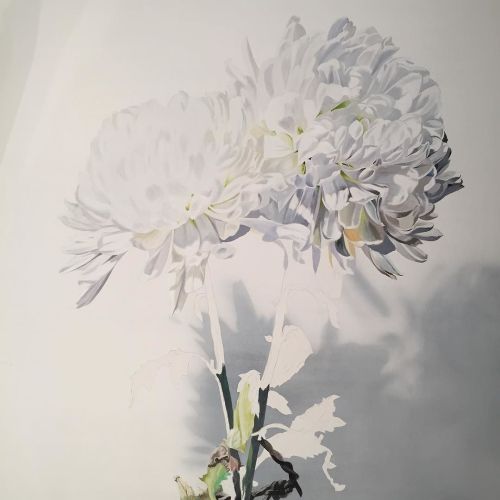
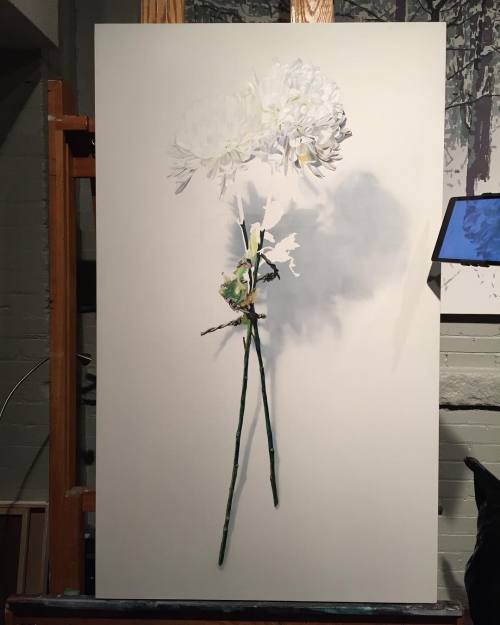
When out west visiting my folks, I'm up by 6:30 to join my dad and the guys for coffee. Mostly contractors, they discuss jobs they are working on, trucks, and of course local politics. On my last visit in March there was a lot of talk about the weather - how warm it was - and then one day I awoke to a fresh snowfall. It was as beautiful as only a fresh layer of snow can be. After coffee, I headed out with my camera to see what I could capture.
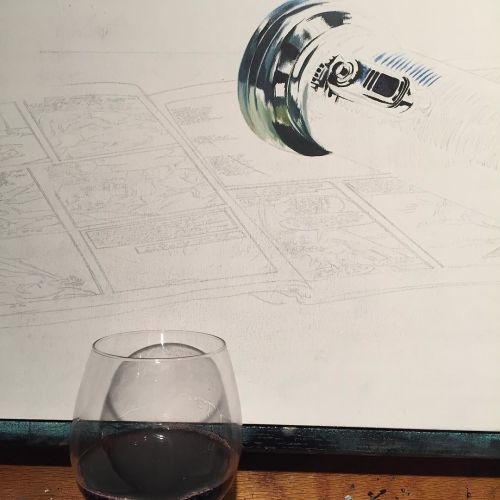
This canvas is based on some of those photos. This represents my third painting session on it but it seems to be moving very well. I think I will call it “Last snow” as it turned out to be the very last snow fall.
A copy of the Mona Lisa has been discovered in the Prado which was painted in Leonardo’s studio—created side by side with the original that now hangs in the Louvre. This sensational find will transform our understanding of the world’s most famous picture.
Conservators at the Prado in Madrid recently made an astonishing discovery, hidden beneath black overpaint. What was assumed to be a replica of the Mona Lisa made after Leonardo’s death had actually been painted by one of his key pupils, working alongside the master. The picture is more than just a studio copy—it changed as Leonardo developed his original composition.
The final traces of overpaint are now being removed by Prado conservators, revealing the fine details of the delicate Tuscan landscape, which mirrors the background of Leonardo’s masterpiece. Darkened varnish is also being painstakingly stripped away from the face of the Mona Lisa, giving a much more vivid impression of her enticing eyes and enigmatic smile. In the Louvre’s original, which will not be cleaned in the foreseeable future, Lisa’s face is obscured by old, cracked varnish, making her appear almost middle aged. In the Prado copy we see her as she would have looked at the time—as a radiant young woman in her early 20s.Leonardo da Vinci, and particularly his masterpiece the Mona Lisa, attracts endless sensationalist theories. However, the discovery of the contemporary copy has been accepted by the two key authorities, the Prado and the Louvre. Uncovering the truthUntil recently, curators at the Prado had no idea of the significance of their copy of the Mona Lisa. There are dozens of surviving replicas from the 16th and 17th centuries. The Madrid version was believed by some specialist to have been painted fairly early, but the absence of the landscape background meant that it aroused little interest (there is no substantive entry on it in the Prado’s collection catalogues).Although the portrait is finely painted, the dull, black background had a deadening visual effect on the image of the young woman. The sitter is generally believed to represent Lisa Gherardini, the wife of the Florentine cloth merchant Francesco del Giocondo.The Prado’s painting was until recently assumed to be on oak (rarely used in Italy at the time) and therefore a work by a northern European artist. José Ruiz Manero, the author of a study of Italian art in Spanish collections, concluded that the picture was Flemish.Last year, the panel was examined and found to be walnut, which was used in Italy (as is poplar, used for the original of the Mona Lisa). In size, it is close to that of the original: the Louvre’s painting is 77cm x 53cm and the Prado’s copy 76cm x 57cm.In a paper presented two weeks ago at a technical conference at London’s National Gallery, coinciding with its exhibition “Leonardo da Vinci: Painter at the Court of Milan” (until 5 February), conservators revealed that they had discovered that the black background was a later addition. This conference was not covered in the media (for a report, see our February print edition).A striking photograph was presented at the conference, showing the picture’s condition after 90% of the black overpaint had been removed, leaving just a small section in the upper right. Visually, the landscape transforms the work, bringing the picture to life.There was an even greater surprise: infrared reflectography images of the Prado replica were compared with those obtained in 2004 from the original of the Mona Lisa in the Louvre. This process enables conservators to peer beneath the surface of the paint, to see underdrawing and changes which evolved in the composition.The underdrawing of the Madrid replica was similar to that of the Mona Lisa before it was finished. This suggests that the original and the copy were begun at the same time and painted next to each other, as the work evolved. Identifying the painterIt is quite possible that Leonardo’s assistant met Lisa and may even have been present when she sat for the master. Although no drawings survive, Leonardo probably began by sketching her face and pose. She may also have come to the studio when finishing touches were being applied to the face in the painting.The Prado's technical specialist Ana González Mozo describes the Madrid replica as “a high quality work”, and in the paper she presented at the London conference, she provided evidence that the picture was done in Leonardo’s studio. The precise date of the original is uncertain, although the Louvre states it was between 1503 and 1506. Bruno Mottin, the head conservator at the Centre de Recherche et de Restauration des Musées de France, believes that the most likely painter of the Prado copy was one of Leonardo’s two favourite pupils. Mottin proposes that it was either Andrea Salai, who originally joined Leonardo’s studio in 1490 and probably became his lover, or Francesco Melzi, who joined around 1506. If the Prado replica is eventually attributed to Melzi, it suggests a late date for the original. What the copy revealsThe Madrid copy of the Mona Lisa is important for what it tells us about Leonardo’s studio practice. The production of a second version, painted alongside the original, is intriguing. It adds credence to Martin Kemp’s theory that Leonardo may also have had a hand in both versions of The Madonna of the Yarnwinder, 1501-07, one owned by the Duke of Buccleuch and the other by a New York private owner (formerly in the Lansdowne collection). But what is most exciting about the Prado replica is what it reveals about Leonardo’s original. In the Madrid copy there are areas that are better preserved than in the Louvre painting. The replica gives us more detail of the spindles of the chair, the frill on the edge of the fabric on Lisa’s chest and the semi-transparent veil around her left shoulder, arm and elbow. The Prado's curator Miguel Falomir believes the replica can probably be identified as a portrait listed in the 1666 inventory of Madrid’s Alcazar Palace, although it remains unclear when it first reached the Spanish royal collection. Coming into the lightFalomir suspects the black overpaint was probably added in the mid-18th century. The reason for this addition is obscure, since the background landscape remained in good condition and Leonardo’s original painting was already very highly regarded. The overpaint may have been added to integrate the copy into an interior with other portraits set against dark backgrounds.During the past few months, this black covering has been painstakingly stripped away at the Madrid conservation studio, with the final area of dark overpaint due to be removed in the next few days. Later varnish has also been taken away from the rest of the picture, most importantly the face. The fully conserved replica is expected to be unveiled at the Prado in Madrid in mid-February. It is then due to be loaned to the Louvre in Paris, as a late addition to its exhibition on “Leonardo’s Last Masterpiece: The Sainte Anne” (29 March-25 June). There it will be seen in the same galleries as the original, giving specialists and visitors the first chance to compare the two works. After 500 years, the two versions of the Mona Lisa from Leonardo’s studio will be reunited again.
As a major exhibition opens in Nuremberg, is Germany’s greatest artist a nationalist symbol as well as a national treasure?
By Bernhard Schulz. Features,
Albrecht Dürer, Self-portrait Wearing Fur-trimmed Coat, 1500
In 1500, Albrecht Dürer painted his Self-portrait Wearing Fur-trimmed Coat, now in the Alte Pinakothek in Munich. Unlike his earlier paintings, Self-portrait with Flower, 1493, in the Louvre and Self-portrait at 26, 1498, in the Prado, this work continues to baffle observers. Despite the fact that Christian iconography is now more or less forgotten, most experts believe that the pose shows associations with representations of Christ. Now, half a millennium after the work was completed, the self-portrait seems to equate Dürer with the Saviour of the World. One doesn’t have to know much, or indeed anything at all, about Dürer to get the feeling that the painting came into being at a turning point in history, and Dürer’s importance in the German national consciousness has as much to do with the era in which he worked as with his phenomenal talent.
Dürer’s entry in the handbook of Munich’s Alte Pinakothek states that he “was, until the last century, considered to be the greatest German artist”—as if to say that he no longer merits such a description. Be that as it may, Dürer has come to be seen as a compelling personification of German history, in an era in which nationalism is no longer socially acceptable.
Too precious to lendThe last time the self-portrait went on loan was in 1971—to Nuremberg for the 500th anniversary of Dürer’s birthday in 1471. There, for the first and probably the last time in history, it was shown together with his other two self-portraits. “Die Zeit” proclaimed it the “highlight of the exhibition, the most important event of the Dürer year”. But the trip was not a good one for the wood panel painting. After its return, it displayed an enlargement of a crack that first appeared in 1928, when it was previously on loan to Nuremberg. Back in 1971, little fuss was made of this—but this year, the controversy was huge. Martin Schawe, who is responsible for old German and early Netherlandish painting at the Alte Pinakothek, is still amazed by the dynamic that has developed around the exhibition, “The Early Dürer” at the German National Museum in Nuremberg (24 May-2 September). From the very first conversations between the Munich and Nuremberg museums, the representatives of the Alte Pinakothek pointed to the 114-strong list of “unmoveable” works in the collection, including the self-portrait. Three other early works by Dürer were requested, of which two were approved, and one rejected for conservation reasons. Klaus Schrenk, the director general of the Bavarian State Painting Collections, which include the three Munich pinakotheks and 13 art galleries throughout Bavaria, even says that there was “never an official loan request” for the self-portrait. Only when politicians from the Franconian parts of the region began to publicly support the Nuremberg loan, did the museum’s internal process become a political issue with enormous public resonance. All the parties in the Bavarian state parliament—from the Christian Socialists to the Greens—issued emergency motions to make the image available to the German National Museum. Supporters of the local team, FC Nuremberg, held up protest banners at football matches, demanding that the portrait be shown in the city of the artist’s birth. Klaus Schrenk remains upset: “If we had yielded to the pressure, it would have had an enormous effect. It would have meant that the treasures that lie in the museums, could be made available because of political concerns.”Meanwhile, the president of the German National Museum, Klaus-Dieter Lehmann, penned a letter to the Association of German Art Historians defending the exhibition. “The Dürer exhibition” was “never an event-project”, he wrote. Rather, it was the conclusion of a research project that could have led to “new findings of Dürer’s early work, which the exhibition will show through direct comparison of original objects”.At any rate, thanks to the row, it has become clear to everyone that when it comes to Dürer, it is about more than art from 500 years ago. “In his day, Dürer was a world-famous artist,” says Schrenk, and the self-portrait, “a humanist icon”, represents “the humanistic view that human capabilities and progressive thought were no longer divinely preordained”. Dürer’s paintings “tell us with great self-assurance what it means to be human”, he adds. Dürer was the first artist north of the Alps—and one of the first anywhere—to apply the notion of what it is to be human to his own self-image.The year in which the self-portrait was completed, 1500, was predicted to be the year the world would end and the Last Judgment would take place. But the new century was to become one of the most brilliant in the history of humanity. The Renaissance, the revival of interest in classical antiquity, made its present felt right across Europe, spreading across the Alps into the German Empire, which dubbed itself the “Holy Roman Empire of the German Nation”, emphasising its age-old connections with the capital of Christianity and Rome’s classical and post-classical culture. For centuries, German rulers had gone to the city to be crowned emperor by the Pope: Rome and the Papacy played a decisive role in the political history of Germany. Martin Luther, an obscure Augustinian monk, had not yet formulated his 95 theses criticising Catholic theology, which he then posted on the door of the Castle Church in Wittenberg. That happened—if it really did happen this way—in 1517. But these were nonetheless troubled times. As the first artist in Germany to sign his work, Dürer was the prototype of a new breed—the independent artist not the dependent court painter. While in Venice in 1506, Dürer famously remarked: “Here I feel like a gentleman, at home I am a parasite.” He wrote at length about his career, particularly in his 1524 family chronicle. Written in the artist’s mature years, this was a highly unusual document for the period.He travelled to Italy. And on this first journey in 1494-95, he produced the first pure landscapes and city vedute ever seen in northern European art. During celebrations to mark the 500th anniversary of the artist’s birth, the Dürer watercolours, which disappeared from the Kunsthalle in Bremen after the Second World War, were described as “the most serious wartime loss of German works of art”. (They turned up again in Russia in the possession of a private collector who refused to return them to Bremen.) By the time of his second visit to Italy in 1505-06, Dürer had become famous throughout Europe. He spent most of the time in Venice, the republic where artists could practise as professionals, free to decide whom they worked for and what subjects to tackle. His meetings with fellow artists, especially with the older and much-admired Giovanni Bellini, made a great impression on Dürer. It was Bellini’s use of colour that would have the most lasting impact on his art.An artist who crossed boundariesThe fact that Dürer crossed the Alps, and when he returned home found ways of fusing the realism of the north and the southern “art of the mind”, led him to be regarded as the supreme representative of the north-south synthesis. In the early 19th century, this idea was seized upon once more as it found new and more intense expression than ever before in allegorical paintings of Italia and Germania. Historical circumstances after the mid-16th century, only a few decades after Dürer’s death in 1528, made it impossible to emulate the artist and his travels. The tragedy of the Thirty Years’ War left the German Länder devastated in every sense, sidelined as modern territorial states took shape across Europe.In many aspects, Dürer was an innovator. Not only did he devise techniques and explore modes of representation, he exploited them with a virtuosity that is unequalled. With his Apocalypse, 1498, Dürer succeeded in creating graphic art for a mass audience. At the same time, he produced a popular edition in German, paving the way for Luther’s translation of the Bible which, with the publication of the New Testament in 1522, established German as a written language. Dürer was the first artist on German territory to publish theoretical works. Since he went to great lengths to demonstrate the scientific basis of art, he also achieved prominence as a naturalist and mathematician. Finally, Dürer entered the political arena as a member of the Great Council in his home city of Nuremberg. If ever there was a renaissance man in Germany it was Dürer: the first to so describe him was none other than the Italian Giorgio Vasari in his Lives of the Artists.The German ApellesDürer was celebrated by his contemporaries as “the German Apelles”. The title was first coined by the humanist scholar Conrad Celtis as early as 1500. The self-portrait seems less presumptuous when we consider the fulsome praise heaped upon its creator. Apelles, the Greek painter at the court of Alexander the Great, was chosen to reflect not only Dürer’s stature as an artist but also his relationship with Maximilian I, the Habsburg Holy Roman Emperor and King of the Germans. For its time, it would be difficult to imagine a greater honour. Nuremberg and the contemporary cultured elite, as well as Germany as a whole, saw Dürer as a heroic figure who could be compared with the great artists of the Italian Renaissance while remaining unique. Dürer himself was aware of the status he held. This is clear from his writings in which he repeatedly alludes to a “German nation” transcending all political boundaries existing at the time. In writing about art, Dürer uses a word of his own invention—Wiedererwaxsung, a composite of the German Wiedererwachen (reawakening) and Wachstum (growth). He uses the same word as his own unique translation of the Italian rinascita (renewal or rebirth), with which he was familiar through his close contact with Nuremberg humanists and his own experience in Venice. Admiration for Dürer has never diminished. A century after the artist’s death, Elector Maximilian of Bavaria, who was obsessed with the desire to amass a collection of Dürer’s work at his official residence in Munich, acquired the Four Apostles from the Free Imperial City of Nuremberg. The sale of the diptych created specifically for the city, which came about through “diplomatic pressure”, soured the relationship between Munich and Nuremberg. All the more so, when the Catholic Elector ordered the quotation from Luther’s translation of the Bible at the foot of the painting, with its obvious Reformist connotations, to be covered up. (It was not until 1922 that the text that was crucial to the understanding of the painting was returned to its rightful place.)At the beginning of the 19th century, with the break-up of the old German Empire during Napoleon’s German campaign, the Franconian region and the hitherto independent city of Nuremberg became part of Bavaria—a reward from Napoleon to mark his alliance with Bavaria against the old German Empire. This territorial gain, which virtually doubled the size of Bavaria, was confirmed nine years later at the Congress of Vienna in 1815. The 19th century saw efforts by the kings of Bavaria—the Wittelsbach ruler also had the French conqueror Napoleon to thank for this promotion in rank—to integrate the Franconian regions, whose population was and is mainly Protestant, into Catholic Bavaria. Even in Dürer’s lifetime, Nuremberg showed support for the Reformation, while feelings of national consciousness were emerging. When Dürer died, the humanist Willibald Pirckheimer quite independently described him as “the pride and glory of our nation”. A Christian artistSome go further, believing that Dürer personifies the religious conflict that split Germany into Catholic and Protestant regions (albeit to some degree settled by the Peace of Augsburg in 1555). In his later years, Dürer embraced the ideas of the Reformation, as did most educated people, not only north of the Alps but far beyond Italy. At the same time, however, as the Council of Trent, 1534-63, formulated the ideals of the Counter-Reformation, it named Dürer as a prime example of the Christian artist. It was precisely this limited view of Dürer as the painter of Christian subjects—including altarpieces like The Feast of the Rosary, 1506, now in Prague—that romantic artists appropriated around 1800. Mostly from the Vienna Academy, practising in Rome and calling themselves the “Brotherhood of St Luke”, the young artists chose Dürer and Raphael as their role models. Before his premature death, Franz Pforr produced a drawing entitled Dürer and Raphael before the Throne of Art, 1810, a symbolic depiction of the fusion of art and religion. Then, in 1815, came Friedrich Overbeck’s Italia and Germania, an allegory of the German yearning for Italy, which still attracts visitors in the Neue Pinakothek in Munich. In 1833, King Ludwig I of Bavaria acquired the painting which, according to Overbeck “speaks of the perpetual yearning of the north for the south, for its art, its countryside and its poetry”. This philosophical view of art adopted by the Nazarenes, a group of young painters in Rome, influenced the entire German romantic movement in the early decades of the 19th century. Dürer was seen no longer as a representative of the secular Renaissance but as an artist with a Christian approach to art and life. National heroIn the course of the 19th century this view became overlaid by a burgeoning nationalism, connecting the age of Dürer with a flourishing German Empire under a strong ruler, epitomised by Maximilian I and later by Charles V. The term “the age of Dürer” became synonymous with this idea and Nuremberg a place that Germans longed to see. The citizens of Bismarck’s newly-created Germany identified with the upper classes of Nuremberg and took Richard Wagner’s 1868 opera “The Mastersingers of Nuremberg” as a guide to art appreciation. Wagner ends his opera with a couplet claiming that although the Holy Roman Empire may fall, “holy German art” will endure. At this time, reproductions of Dürer’s Young Hare, 1502, Great Piece of Turf, 1503, and especially Praying Hands, 1508, became regular features of the interior décor in the homes of the German bourgeoisie, while intellectuals adorned theirs with one of the three so-called “Meisterstiche”, or master prints, notably Melancholia I, 1514, which is still not fully deciphered.It was a comparable surge of political nostalgia that led to the creation of the German National Museum, which will shortly be staging the exhibition at the heart of the dispute. The museum founded in 1852 was, and still is, funded by the Bavarian government, a compensation for Munich’s status as Bavaria’s political centre. In the 20th century, however, the museum paled in significance, especially after the destruction of Nuremberg in the Second World War. Nevertheless, when it staged an exhibition to mark Dürer’s 500th birthday in 1971, it attracted 360,000 visitors, the first blockbuster in German post-war history.It also seemed obvious in 1948, with the introduction of the new West German currency the Deutsche Mark, that Dürer illustrations should adorn the new banknotes. The most commonly used ten-mark banknote showed the portrait of a young man, strongly resembling the one depicted in Dürer’s self-portraits. Dürer was literally in everyone’s hand. In a showcase at the exit of the Alte Pinakothek, a copy of the museum catalogue lies open at page 104—a double-page spread showing the Dürer self-portrait. A note mentions the simmering dispute with Nuremberg and the importance of the Alte Pinakothek as a museum for everyone. There is no mention of the fact that, in 1805, the painting was sold in suspicious circumstances to the Elector, later King, of Bavaria, by someone we would now call a con artist. By today’s standards, Dürer’s portrait is a looted work of art. Nuremberg’s pain is still deeply felt, for it concerns the most important artist Germany has ever produced. “The Early Dürer” is at the Germanisches Nationalmuseum, Nuremberg, 24 May-2 September.
Identifying the assistant who worked on the copy in Madrid could lead the Louvre to reassess the original’s early provenance
By Martin Bailey.
Leonardo’s “St John the Baptist”, 1513-16, in the Louvre—some scholars believe that Salaì was the model
The Prado’s copy of the Mona Lisa was most likely painted by Salaì, Leonardo’s assistant and reputed lover. Salaì, whose nickname means “little Satan”, joined his master’s studio in 1490, at the age of ten, and worked with him until Leonardo’s death.
Giorgio Vasari, the mid-16th century art historian, described Salaì as “a graceful and beautiful youth with curly hair, in which Leonardo greatly delighted”. It has long been believed that Salaì and Leonardo were lovers, although there is no firm evidence of a sexual relationship.
The identity of the studio assistant who painted the Prado’s copy of the Mona Lisa is still being investigated, but Salaì (whose real name was Gian Giacomo Caprotti) has now emerged as the top contender. On 21 February, the newly-restored copy of the Mona Lisa, done side-by-side with Leonardo’s original in his studio, was unveiled in Madrid. The Louvre dates the original to about 1503-06.If it is confirmed that Salaì was the copyist of the Mona Lisa, then it is unlikely that he once owned the original, as has previously been assumed. The Louvre would then have to reassess the early history of the world’s most famous painting.In attempting to identify the copyist, curators at the Prado began by eliminating pupils and associates such as Boltraffio, Marco d’Oggiono and Ambrogio de Predis—since they each have their own individual styles. They also eliminated two Spanish followers of Leonardo, Fernando Yáñez and Fernando de Llanos, whose work is distinctively Valencian.Miguel Falomir, the head of Italian paintings at the Prado, now believes that the copy of the Mona Lisa “can be stylistically located in a Milanese context close to Salaì or possibly Francesco Melzi”. Melzi was an assistant who joined Leonardo’s studio in around 1507, but the Prado’s copy may well have been started earlier. Of the two, Salaì now seems the most likely.Bruno Mottin, the head curator at the Centre de Recherche et de Restauration des Musées de France (based at the Louvre), concurs. He believes that Melzi is less likely, and although Salaì’s style remains obscure, he is the most likely candidate.Little SatanSalaì’s nickname came from his behaviour. Leonardo described him as “a liar, a thief”, but admired his artistic talent. There are very few works which have been attributed to Salaì, although a Salvator Mundi signed by him was sold at Sotheby’s on 25 January 2007. The St John the Baptist at the Pinacoteca Ambrosiana in Milan, a variant of Leonardo’s picture now in the Louvre, has also been said to be by Salaì.A third painting, in America, is now also being currently reattributed to the Workshop of Leonardo and Salaì. It is a copy of The Virgin and Child with St Anne (original in the Louvre, 1503-19), in the collection of the Hammer Museum, University of California, Los Angeles. This copy will be shown at the Louvre’s forthcoming Leonardo exhibition (29 March-25 June).On Leonardo’s death in 1519, Salaì is thought to have inherited some of his master’s paintings as well as part of his vineyard. Salaì died a violent death five years later, from stab wounds. In 1991, an inventory was discovered which showed that he had left a painting known as “La Joconda”, an obvious reference to the sitter, Lisa del Giocondo. It was valued at 100 ducats. Until now, it has been assumed that Salaì must have inherited Leonardo’s original of the Mona Lisa, which was acquired by the French King, François I. However, if the Prado’s copy was done by Salaì, then it suggests that the Mona Lisa he owned (and possibly some of his other “Leonardos”) were actually versions he had made. This would mean that Salaì had not inherited the original of the Mona Lisa, so its early provenance will now have to be completely rethought.Interestingly, Vasari reported that “some of the works attributed to Salaì in Milan were retouched by Leonardo”. Although so far, there has been no serious proposal that Leonardo’s hand can be seen in the Prado version of the Mona Lisa, Vasari’s comment does suggest that Salaì had made copies of his works.Journey to SpainAlthough Salaì had moved to France with Leonardo in 1516, he returned to Milan on his master’s death. How then did the Prado’s copy of the Mona Lisa reach Madrid?Falomir proposes that there are two possible routes. The first is with a Spanish governor or administrator who had been sent to Lombardy, which was then ruled by Spain. An obvious candidate would be the Marquis of Leganés, who became the governor in Milan in 1635. He was one of the greatest art collectors of his day, amassing over 1,000 pictures. The marquis died in 1655 and some of his works ended up in the Spanish royal collection and eventually the Prado.The second suggestion is that the copy of the Mona Lisa could have been bought by the sculptor Pompeo Leoni, who was born in Venice and worked in Milan and then mainly in Madrid. He was an avid collector and owned important works of art and manuscripts by Leonardo. Although a Mona Lisa is not recorded in his estate inventories, following his death in Madrid in 1608, it is possible that he had brought the copy to Spain, but disposed of it before he died.So far, the earliest accepted reference to the Madrid copy of the Mona Lisa is a “female portrait by Leonardo”, which in 1666 was hanging in the Galleria de Mediodía of Alcázar Palace. The Prado’s director of collections Gabriele Finaldi remains hopeful that further archival research will reveal more about the mysterious past of the museum’s copy. And if Salaì’s authorship is accepted, then it will be necessary to reconsider the early provenance of the original of the Mona Lisa—how did it reach King François I, who hung it in his palace in Fontainebleau in the early 1540s?
Leonardo’s original “The Virgin and Child with Saint Anne”, 1510, in the Louvre
“It took a lot of gall – guts – to paint it,” Henri Matisse was known to have said about his once-controversial Fauve-period paintings, “but much more to buy it.” So recalled his grandson, Claude Duthuit, in a November, 2010, interview, a few months before Duthuit’s death.
The Cone sisters and their art collection
Among those who had the guts were Claribel and Etta Cone, Baltimore sisters who during the early 20th century amassed an extraordinary collection, which included more than 3,000 works, including about 500 by Matisse. In the end, the Cones amassed the largest and most comprehensive private collection of Matisse and struck up an important friendship with the artist.
Works from their renowned collection (which also includes 114 works by Picasso, as well as paintings by van Gogh, Cézanne, Gauguin, Renoir, Pissarro and others) are part of this summer’s major show at the Vancouver Art Gallery, Collecting Matisse and Modern Masters: The Cone Sisters of Baltimore, which opens May 26.
While the art is remarkable, so is the story of these sisters’ lives.
Born to German-Jewish immigrants (the family name was originally Kahn) in 1864 and 1870 respectively, Claribel and Etta Kahn were women ahead of their time: intellectually curious and accomplished (Claribel was a medical doctor), and self-taught but prescient in their collecting habits.
“Some of it was luck and friendship, but as they began their collection and started to move forward, their eyes became better and their selections became better. They certainly, for women collectors in the United States, put together one of the greatest modern collections this country had ever seen at that point,” says Katy Rothkopf, senior curator of European painting and sculpture at the Baltimore Museum of Art, where she is responsible for the Cone collection.
Long before they were buying art, the women held Saturday night gatherings that became well-known among Baltimore’s smart set. Among those who attended were the avant-garde writer Gertrude Stein and her brother Leo, who lived in Baltimore for a time. It’s likely that the Steins derived the idea for their legendary Saturday evening Paris salons from the Cone sisters, according to an essay by Karen Levitov, associate curator at the Jewish Museum in New York, which created the exhibit.
The sisters bought their first works of art in 1898. Their father had died the previous year and their eldest brother gave Etta $300 to spruce up the family home. Instead of spending it on traditional décor, she bought five paintings from the estate sale of the American impressionist Theodore Robinson.
The Cones’ collecting began in earnest a few years later in Europe, where the sisters were able to travel regularly thanks to the stipend they received from their brothers, whose textile empire became a major supplier of denim and other materials to Levi Strauss & Co., and, during the First World War, to the U.S. armed forces.
In Paris, the Steins introduced the Cones to important art – and artists. On Oct. 18, 1905, they attended the Salon d’Automne, an alternative to the conservative official Salon. It was groundbreaking, but also controversial; that year, one critic famously compared the art to the work of wild beasts (fauves) – which led to the moniker Fauvism. The work was shocking and even Leo Stein called Matisse’s Woman with a Hat “a thing brilliant and powerful but the nastiest smear of paint I had ever seen.” A few days later, he bought it.
A few weeks later, Gertrude brought Etta to the rundown studio of Pablo Picasso, then virtually unknown, and Etta bought several drawings. More Picassos would follow, including a portrait of Claribel and – a surprise sent in the mail to Baltimore – a pen and ink self-portrait with the words “Bonjour Mlle. Cone” written across the top.
The following January, they met Matisse, and Etta bought two drawings and shortly thereafter her first Matisse oil painting: the Fauve-period work Yellow Pottery from Provence. By the end of that year-and-a-half stay in Paris, Etta had acquired 28 works.
“I think once they sort of got hooked, a lot of the appeal was because they became friends with many of the artists, particularly with Matisse and to a lesser extent with Picasso,” Rothkopf says. “And I think the other thing that really hooked them was that these were souvenirs from time spent abroad. Most of the collection was put together with works bought out of the country. ... I think it was sort of part of being in a place that was more fun and more exciting and more thrilling than life back in Baltimore.”
While the relationship ultimately waned, Stein was an important friend and, for Claribel, perhaps more (a diary entry hints at possible intimacy). Etta typed the manuscript for Stein’s Three Lives, and Stein wrote about the sisters in a word portrait, Two Women: “There were two of them, they were sisters, they were large women, they were rich, they were very different one from the other one.”
(Incidentally, the exhibition The Steins Collect: Matisse, Picasso, and the Parisian Avant-Garde is currently installed at the Metropolitan Museum of Art in New York.)
The art hung in their adjacent apartments in Baltimore. Claribel had amassed such a huge collection that she ultimately moved to a different apartment on another floor. Her art stayed – even after her death.
Claribel collected to the end, literally. She purchased her last painting – Gustave Courbet’s The Shaded Stream at Le Puits-Noir – on September 20, 1929, the day she died.
The following year, Matisse, who was in Philadelphia doing work for the Barnes Foundation, travelled to Baltimore to offer his condolences to Etta, and stayed overnight in her guest room. In the apartments, he was confronted by the reality of the Cone collection and what it could mean for his artistic legacy.
“He was completely amazed by what they had been able to put together,” Rothkopf says. “Up to that point, I think up he thought they were important collectors, there’s no question. But after he saw what they had done, I think he really realized that if he played his cards right, he could have a major presence in a major east coast museum.”
Matisse then began making work with Etta Cone in mind: aware of the collection’s public destiny.
As he created Large Reclining Nude over a six-month period, he photographed its progress, mailing 22 pictures to Etta documenting its various stages. She ultimately bought the work, hanging it in Claribel’s apartment across from the tremendous Blue Nude, which had formerly been in Leo Stein’s collection.
The last Matisse oil that Etta bought was Two Girls, Red and Green Background.
Matisse was right to bet on the Cones: When Etta died in 1949, she bequeathed her collection (which included Claribel’s art) to the Baltimore Museum of Art, along with $400,000 to build a Cone Wing.
Rothkopf believes the Cone sisters were more than simply wealthy patrons for Matisse.
“It wasn’t just a financial thing,” Rothkopf says. “Particularly after having seen what she put together in 1930, he wanted her to have some of his best things and really there’s some beautiful letters back and forth between them that are really quite illuminating. They were both very good for each other. He didn’t take commissions, she didn’t do commissions. ... He would make things that I think he knew that she would love.”
Collecting Matisse and Modern Masters: The Cone Sisters of Baltimore is at the Vancouver Art Gallery May 26 to Sept. 30.
Multitasking just got a whole lot sexier: New York couples can now make love and art at the same time.
Artist Alexander Esguerra has spent the last two years inviting couples to create their own Jackson Pollock-esque masterpieces by making love on a paint-covered canvas.
“Love is a powerful creative force,” says the Parsons graduate. “It really makes everybody feel like artists.”
Esguerra began “Love & Paint” back in 2010 after a particularly powerful night of passion, the 30-year-old lower East Sider reveals.
“I woke up one morning after a sexual encounter and my normally organized room was a mess,” he said, “I wanted to artistically capture those moments through the act of sex that our bodies interacted and affected the space around us without bringing in that whole played-out porn spiel.”
He has since helped nearly 50 couples bump and grind while slathered in various colors of nontoxic, water-based paint.
It’s all meant to demonstrate both the universal and inimitable qualities of sex.
“Sex is basically the great equalizer,” he said. “You look at these paintings and you can’t tell if the couple was gay or straight or old or young or married or cheating.”
And while Esguerra enjoys “exploring the power of sex,” and has even created his own sex painting, he is no voyeur.
After covering the floor in plastic, setting up the canvas on a heated surface, pouring carafes of paint and lighting candles, the artist leaves the couples to their own devices.
“When I leave the room, they are in total privacy,” he said. “I tell them to take the paint, lay on top of the canvas and pour it on each other. Look in your partner’s eyes and make love as you would normally. Have fun with the paint, but don’t make it all about the paint.”
Caroline and Tom Law, an upper West Side couple in their 60s, were intrigued by the opportunity to participate in Esguerra’s project.
“I found it very relaxing and pleasurable and freeing,” said Caroline, who is a designer like her husband. “It was just cool to use my body as a paintbrush. It’s like adult finger painting.”
And how did the painting turn out?
“It's beautiful,” said Tom. “The painting is hanging in our living room. Most visitors don’t know the origin, so they just think it is modern art. But if they ask, we’ll tell them how we did it.”
Ondriana and Natalia, a lesbian couple from the West Village who asked to be identified only by first names, said they “have never done anything like this.”
They painted their masterpiece during a party.
“We were in a dark room with a single candle and there were a bunch of people outside the door,” said Ondriana. “But the second the lights went out and the door closed, it was like we were in a whole other world. We just kept covering ourselves in paint. It was magical.”
And they learned something from the process as well.
“Put your hair up,” said Natalia. “It’s easier to get the paint off your body.”
The art project has proven so successful that Esguerra recently turned it into a business. He now sells “Love & Paint” packages, starting at $2,500, in which couples can experience making their own sexual masterpiece in an upscale New York City hotel.
“It has become so much more powerful than sex,” he said. “It is more like relationship therapy, a joyous experience for the couples to celebrate their love.”