Saturday, February 2, 2013

The Complicated Business of Spotting an Art Forgery

When people who are shopping for original art ask me "How can I tell if a piece of art is a forgery or not?", my answers are simple and complex. The simple answer is: If you collect art for the love of art, buy directly from the artist. Unless you are in the room with the artist as she or he creates your work of art, there is no way to guarantee that they did the work. The complex answer is: Why does it matter if the artwork was actually done by the person to whom it is attributed? Does the value of a work of art lay in the price a buyer is willing to pay, or in the emotional impact the work has on the owner? Art galleries and auction houses have been known to sell forgeries, just as artists have been known to sign forgeries of their own works -- Picasso for example. Value is relative, and whether a work of art is a forgery should not matter if the work of art gives you fulfillment.

Consider that while my mother and I ran Forgery of the Month Club in the 90s, 99 percent of our customers were middle class. Virtually all of them believed they could never afford to own a work of two-dimensional art that was actually done by a well-known or famous artist. In response to that market demand, Forgery of the Month Club produced signed Rembrandt drawings, Picasso drawings and prints, Toulouse Lautrec and Whistler sketches, and works in the style of other well-known artists. Because all our customers knew mom actually did these works, we sold them at affordable prices while breaking no laws. The legal violation would have occurred if we had attempted to sell them as works produced by the attributed artists. Customer satisfaction was 100 percent.

Consider one of Vincent Van Gogh's "Portrait of Dr. Gachet" which sold for $147 million in 1990. Certainly supply and visual seductiveness played a role in creating demand for this painting, but $147 million worth? "Portrait of Dr. Gachet" sold for that inflated price not because there was immutable proof that he actually painted it, but for several other reasons: there was agreement that 100 years ago Vincent Van Gogh painted it; he is one of the most loved Western painters ever; it was considered a relatively safe investment and because it was sold at auction. People who attended that auction, and similar other auctions are, aside from being wealthy, competitive. That is a characteristic that is crucial to auction houses fattening their bottom lines. It is the unwillingness between bidders to lose which drives up the price and creates the emotional cachet of the authenticity of the artwork up for auction. The $147 million paid for "Portrait of Dr. Gachet" reflects an individual's ability to pay, and their desire to dominate, or to win. Additionally the exorbitant price paid for the piece adds a compelling and emotional bettina to the work, whether or not the painting was done by Van Gogh.

Anything man can invent, man can circumvent. Let us say for example, that you are interested in purchasing a small sketch by the Flemish Baroque painter Peter Paul Reubens, who lived in the 16th century. You shy away from competing, you don't have millions to spend, and you are passionate about Reubens work. You commission Forgery of the Month Club to draw one for you. To circumvent living in the 21st century rather than in the 16th century, mom needs paper and ink from the 16th century, knowledge of Reubens body of work, and the ability to draw in his style. For the paper to be authentic, mom finds a book from that era, and carefully tears out the cover sheets. For the correct ink, she finds a recipe for the type ink Reubens used, and after two or three days practicing, mom draws in the style of Reubens, paying careful attention to line quality, proportion and the eyes of the subject. Because no catalogue of an artist's work is ever exhaustive, this sketch is attributed to Reubens. There are enough points of comparison on the sketch to pass microscopic inspection.

Forgery, however, is not limited to works of art. Provenance, which is essential for most if not all transactions in today's art world, can be forged as well. Yet the means of declaring an art work genuine however, are just as available to today's forger as they are to contemporary art specialists, investigators or auction houses.

If you wanted provenance mom might write a complaint letter to the president of Sotheby's, Christies or an insurance company. When their response letter arrived on letterhead, mom would slice it off and paste it to the provenance letter she had typed on her 1942 Olivetti typewriter. She would sign the name of a deceased employee, or a favorite pet then Xeroxes the letter eight or nine times for weathering. If that was too cumbersome, she might create a letterhead for a fictitious, but defunct insurance company, or ask me to research museum marks, and create one with which to stamp the back of the sketch.

When mom presents you with the sketch, your heart races. You are thrilled, and pay her $750. It hangs elegantly on your wall, and you feel great looking at your Reubens. Friends and family croon over it. Does it matter if mom did the sketch? Will it matter in one hundred years? Was it worth $750?

Fake Picasso: California Dealer Charged With Selling Phony Painting

Fake Picasso

LOS ANGELES — A West Hollywood antiques dealer has been charged with selling a phony Picasso for $2 million.

Federal prosecutors said Friday that 69-year-old Tatiana Khan was charged with wire fraud and other crimes. She's free pending arraignment but could face 45 years in prison if convicted.

A call to her lawyer wasn't immediately returned.

Prosecutors contend Khan paid an artist $1,000 in 2006 to duplicate a Pablo Picasso pastel called "The Woman in the Blue Hat" and sold the forgery for $2 million.

The FBI stepped in last year after the buyer had the work examined and learned it was a fake.

On Friday, FBI agents seized a genuine Willem de Kooning painting from Khan. Authorities claim she bought it for $720,000 using proceeds from the Picasso sale.

Friday, February 1, 2013

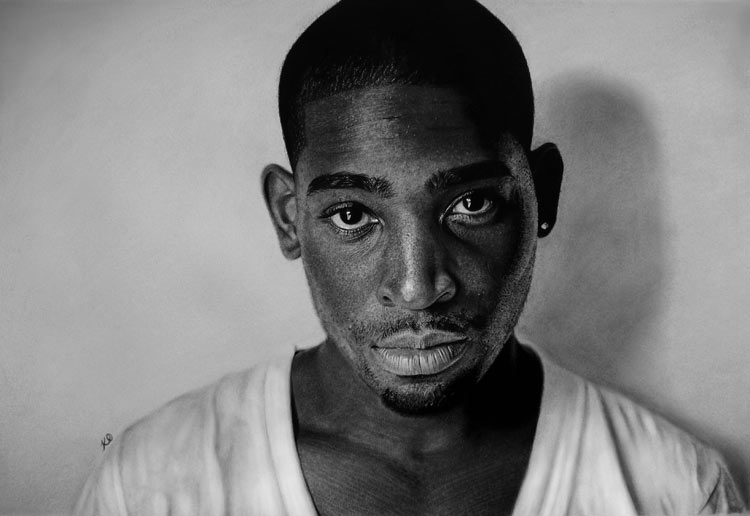
Kelvin Okafor's drawings may look like photographs but are they art?

The 27-year-old's meticulous depictions of celebrities stand out in a culture that values video, performance, anything but drawing

Kelvin Okafor's portrait of Tinie Tempah. View larger picture
Kelvin Okafor's portrait of Tinie Tempah. Image: Kelvin Okafor

Kelvin Okafor is a miraculous artist. If Leonardo da Vinci was alive today and he saw what Okafor has achieved with pencil, paper and a bit of charcoal, he would recognise a talent well worthy of his respect – a brother in art. So would the Dutch painter Jan Vermeer, or the Baroque genius Caravaggio.

All these great artists thought their job was to recreate, with a steady hand and a keen eye, the wonder of life. Okafor brings that craftsmanlike aspiration into the modern world. His drawings are based on photographs of celebrities – the same kinds of photograph we all see everyday. But instead of turning the page or clicking to another site after a second or two, this artist looks. He looks hard. It is an act of love and imagination to look as hard as that. The drawing skills with which he renders what he sees are truly sublime – it is amazing such skills even exist in a culture that places so little value on them. Art schools today encourage their students to think about video, performance, concept, anything but pure meticulous drawing. The fact that Okafor has got through that anti-graphic net shows that, in some people, a profound talent for visual depiction is innate, and will always burst out.

Okafor is 27 and lives in Tottenham, north London where he grew up. He went to Middlesex University. But his drawings are self-evidently a personal fascination: something he has to do. The soft, subtle accuracy of his style can mimic the contours of a photograph. But is that art? Personally I think pictures as skilful as these have an absolute claim to be art whereas most of the art that gets shortlisted for the Turner prize (and I say this as a former judge) has only a relative claim to be art, which future generations may or may not agree with.

Kelvin Okafor's portrait of Amy Winehouse Kelvin Okafor's portrait of Amy Winehouse. Image: Kelvin Okafor

Perfect drawing has counted as art for at least 40,000 years. In the exhibition Ice Age Art, which opens soon at the British Musuem, there are hypnotically accurate images of bison, lions and horses drawn on to pieces of ivory long before human beings could read or write. Ice-age artists drew the most visible and imposing things in their world, the great herds of mammals that roamed a frozen Europe. Today, what hits our eyes and haunts our minds is not nature but culture, the images of celebrity that fill our screens. It is natural for an artist to draw those.

Kelvin Okafor's portrait of Princess Diana. Kelvin Okafor's portrait of Princess Diana. Image: Kelvin Okafor

Okafor is not alone among modern artists who have fixed their gaze on celebrity photographs. In the 19th century the Iimpressionist Edgar Degas made a painting that meticulously recreated a photograph of Princess Pauline de Metternich. In the 1960s Andy Warhol made haunting silkscreen portraits derived from magazine photographs.

The art world lauds these figures, so it should embrace Okafor. He's still very young. If you can draw like this when you are 27 what can't you do when you are 40? Here is the talent that Damien Hirst can't buy with all his millions.

Should Kelvin Okafor's drawings, so close to photographs, be considered art? Tell us what you think.

Kelvin Okafor's drawings are on display at the Watercolours + Works on Paper Fair 2013 at the Science Museum, London SW7 until 3 February.


http://www.guardian.co.uk/artanddesign/

Saturday, January 12, 2013

The Best New Art Galleries in Toronto, 2012

Posted by Kate Fane  

toronto art galleriesThe best new art galleries in Toronto for 2012 reflect how the traditional boundaries for the city's art scene were almost completely redrawn. Following the mass exodus of galleries from rapidly-gentrifying West Queen West and Lower Ossington to the burgeoning areas of Dundas West and Bloordale, even the New York Times took note of this dramatic shift of an entire community. Thus, over a third of the list of the year's best new galleries are the new locations from among the many that were forced out of their original spaces, or else offshoots of preexisting galleries.

In addition to these familiar names, several exciting new projects were launched this year, ranging from the world-class facilities of the Ryerson Image Centre to scrappy live/work space for some more experimental galleries. Or one can compare the politically incendiary street art on display at Don't Tell Mama with the crowd-pleasing painting and illustration favoured by the Hashtag Gallery. One thing's for sure, wherever its located, the diversity of art production and appreciation in Toronto is at an all-time high.

Here are Toronto's best new galleries of 2012.

Ryerson Image Centre

Ryerson Image Centre

Combine a $70.95 million dollar budget with a priceless collection of 20th century photojournalism, and you've got a clear winner for the title of any city's best new gallery. And by launching innovative and compelling shows that explore the possibilities of the still and moving image, the RIC has ensured its place as an international hub for photography, rather than just a staid archive of its past. More »

Don't Tell Mama Gallery

Don't Tell Mama Gallery

Riding high on the anti-Rob Ford fever that swept much of the city this year, Don't Tell Mama's two major shows featured the work of local graffiti artists-cum-political protestors SPUD and Deadboy, all the while reigniting the debate surrounding graffiti's newfound place on the walls of commercial galleries. More »

Videofag

Videofag

Partners Jordan Tannahill and William Ellis have created something truly special in Kensington Market. This storefront cinema and performance space (as well as home for Tannahill and Ellis) focuses on video and performance art, as well as the work of local and Canadian queer artists operating through a variety of mediums. More »

Art Metropole

Art Metropole

Originally founded by the influential collective General Idea in 1974, this artist-run centre and distributor of unique books, clothing, magazines, recordings, and multiples left its King Street home this summer for a beautiful new space on Dundas West. With its world-class collection and storefront installations, Art Metropole remains one of the best ways to drain an afternoon (and your bank account) in the city. More »

A Nerd's World

A Nerd's World

Ok, so it isn't really a gallery. But the eye-catching work of husband and wife photography team Chris and Grace Hughes made their stylish Bathurst storefront a major draw. More »

Jessica Bradley Annex

Jessica Bradley Annex

As a member of the Toronto art community's old guard, Jessica Bradley has represented some of the city's most renowned artists, as well as almost single-handedly pioneered the gallery boom on Dundas West. With the Annex, a more spacious offshoot of her flagship location, Bradley will surely have the same effect on the decidedly un-gentrified Keele and Dupont area. More »

MKG127

MKG127

It was one of the first galleries to arrive on the Ossington strip way back in 2007, but MKG127 is now just the next in line to leave it. Forced out by spiraling rents, the innovative gallery with a focus on conceptual art has now set up shop along Dundas West, joining many other previous Ossington denizens. More »

Hashtag Gallery

Hashtag Gallery

With its Twitter-referencing name, late-night hours, and frequent drop-in community events, Hashtag Gallery set itself apart with its focus on making local art accessible (and affordable) to the average passerby. Only open since April, the space already has had plenty of successful group shows under its belt. Expect more great things in the coming year. More »

Walnut Contemporary

Walnut Contemporary

Walnut Studios has been one of city's most feel-good stories in the art scene, with a vibrant artistic community and studio space forming out of a scrapped condo development. Now with its own commercial gallery, the Walnut empire seeks to promote local and international artists from outside its studio walls. More »

Tuesday, January 8, 2013

The Lists, To-dos and Illustrated Inventories of Great Artists

by Maria Popova

What a 21-point scale of self-confidence has to do with Adolf Konrad’s carry-on and Picasso’s favorite artists.


We’ve previously taken a voyeuristic look inside the notebooks and sketchbooks of great creators and, today, we turn to an even more private facet of the creative self: the list. Lists: To-dos, Illustrated Inventories, Collected Thoughts, and Other Artists’ Enumerations from the Collections of the Smithsonian Museum offers a surprisingly intriguing glimpse of some of the 20th century’s most remarkable creators — including Pablo Picasso, Joseph Cornell, Willem de Kooning, Mark Rothko, Andrew Wyeth and Janice Lowry, among dozens of others — revealing their personal habits, priorities and decision-making schemata through the lens of the seemingly mundane and, in the process, demystifying artmaking and the creative life.

From a list Finnish-born architect Eero Saarinen made of his second wife’s positive attributes, to designer Harry Bertoia’s 1932 self-rating chart for a school assignment, rating 21 of his characteristics on a spectrum from Very Poor to Excellent, to Picasso’s recommendations of artists he liked for Walt Kuhn’s 1913 Armory Show, these wonderful and fascinating seventy-or-so artifacts reveal as much about their creators as they do about the values, fixations and points of interest of their respective eras.


Eero Saarinen's list of Aline Bernstein's good qualities, ca. 1954. Aline and Eero Saarinen papers, 1857-1972.

Image courtesy of the Smithsonian Institution's Archives of American Art; copyright F+W Media Inc. 2011.


Harry Bertoia's 'My-self Rating Chart' school assignment. Harry Bertoia papers, 1917-1979.

Image courtesy of the Smithsonian Institution's Archives of American Art; copyright F+W Media Inc. 2011.


Pablo Picasso's recommendations for the Armory Show for Walt Kuhn, 1912. Walt Kuhn, Kuhn family papers, and Armory Show Records, 1859-1978.

Image courtesy of the Smithsonian Institution's Archives of American Art; copyright F+W Media Inc. 2011.


Janice Lowry's Journal #98, 2002-2003.

Image courtesy of the Archive of American Art.


Franz Kline's receipt from John Heller's Liquor Store, Dec. 31, 1960. Elisabeth Zogbaum papers regarding Franz Kline, 1928-1965.

Image courtesy of the Smithsonian Institution's Archives of American Art; copyright F+W Media Inc. 2011.


Adolf Konrad's graphic packing list, Dec. 16, 1973. Adolf Ferdinand Konrad papers, 1962-2002.

Image courtesy of the Smithsonian Institution's Archives of American Art; copyright F+W Media Inc. 2011.

Lists comes from Princeton Architectural Press, purveyors of the visually compelling and culturally intriguing. Original images from the book are currently on display at the Morgan Library & Museum in New York until October 2, 2011.

via GMSV; images via Imprint

Friday, January 4, 2013

Vintage Film: Watch Henri Matisse Sketch and Make His Famous Cut-Outs (1946)

In April of 1946, a camera crew recorded the scene as the great French artist Henri Matisse sat down at his easel to make a charcoal sketch of his grandson, Gerard, at his his home and studio in Nice. The brief clip above is from a 26-minute film by François Campaux which was commissioned by the French Department of Cultural Relations. Alas, we’ve been unable to find the entire film online, but you can watch a 15-minute German version on YouTube, or you can visit a Web page at the Art Institute of Chicago for a group of higher quality silent excerpts from the film, accompanied by explanatory captions. In the clip above, we hear Matisse speaking in French. Here is a translation:

Me, I believe that painting and drawing are the same thing. Drawing is a painting done in a simpler way [or with "limited/reduced resources"]. On a white surface, a sheet of paper, with a plume [or "pen"] and some ink, one creates a certain contrast with volumes; one can change the quality of the paper given supple surfaces, light [or clear] surfaces, hard surfaces without always adding shadow or light. For me, drawing is a painting with limited means/resources.

For another glimpse of Matisse at work, look below for a rare color clip (from an unknown source) of the artist at work creating one of his distinctive paper cut-outs.